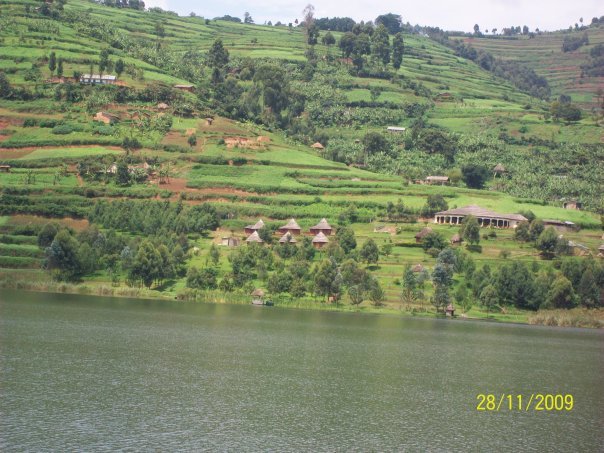
"Mulembe" is a greeting in Lugisu, my language. It is a language spoken by a people who live on the western slopes of Mt. Elgon in eastern Uganda. When literally translated it means "peace." The person being greeted would also respond with the same, "Mulembe." This greeting serves the purpose of declaring no intention of harm. Therefore, I welcome everyone to this blog with, "Mulembe!"
Jun 30, 2011
Jun 19, 2011
How Amin Destroyed Uganda
It was a coup d'etat and it was the first time Ugandans had ever heard of coup d'etat. Idi Amin Dada, a military general, had toppled the government. He made an announcement on the National radio that he had taken over the Government, was the new ruler and was speaking from his "command post." He spoke in broken English. There was jubilation in the streets of Kampala because this military man had toppled President Obote, a leader much resented by the Baganda for having forced the Kabaka of Buganda into exile. Nobody could foresee what was to come.
Amin's reign turned out to be a nightmare. He expelled the Ugandan Asians who were a significant part of the national economy, replacing them with Ugandans who had no skills in business. Soon the shops were bare because commodities were not replaced. Ugandans had to line up for basics like sugar, soap, toilet paper and salt. In order to survive those who were first in line bought more and the resold them at higher prices. "Magendo", meaning black market, was introduced and soon enough everyone was taking time away from their regular jobs to do magendo. Next Ugandans started crossing the border to go into Kenya or to fly to other countries to bring in commodities. They smuggled coffee to Kenya in order get money to purchase essential commodities which they could bring back. It was a rough time. People were insecure and were living from day to day. Dreams for professionals were crashed and they started looking for a way out.
As the Ugandans were suffering, Amin was having fun with his infamous spies, and killing suspected enemies. He killed many Ugandans and dumped them in Namanve forest near Kampala. Women who rejected his advances or advances from his intelligence group were raped and killed. The movies that have been made of Amin are not fiction. Amin did those ruthless things as depicted in the movies. He killed doctors, lawyers, teachers and foreigners. He even killed his wives. Many people doubted his sanity and some accused him of cannibalism.
By the time he was toppled by the Tanzanian forces he had done catastrophic harm to the economy and his people. The Pearl of Africa was no longer attractive to tourists. The new generation needed and still needs serious rehabilitation in many aspects. Few of them understand how to be responsibe citizens because all they know is you have to survive by any means necessary. They are lacking in role models. Take for example a headline in one of Uganda's newspapers, The New Vision June 20, 2011 : "Teachers, parents warned against stealing text books."
Those who remained in Uganda have gone through other Governments but Amin's damage is still strongly felt. Things will never be the same.
When President Museveni came to power he was a breath of fresh air. He removed the road blocks manned by cruel soldiers who were out to rob and harrass citizens, he started rebuilding the economy. Ugandan Asians were invited back to reclaim their businesses and well-stocked supermarkets returned. There is still a lot of poverty in Uganda even though international donors have poured a lot of money into the country. Where this money goes is a mystery ... maybe not such a mystery. Some Government officials have been accused of diverting funds meant for poor people in rural areas for their personal gain. Many are filthy rich! There are lawsuits pending in courts against those who embezzelled the Global Funds money and CHOGM (Commonwealth Heads of Government Meeting) money while the country waits for justice.
As late former President Godfrey Binaisa said: "the chair is sweet." He was alluding to the fact that once you become President, it is hard to give up power. It is obvious President Museveni has found the chair very sweet because he does not seem to want to relinquish power to anyone else.
There are commodities to buy but people don't have the money. Many of them have found ways overseas to work in jobs they would otherwise not do in Uganda, such as driving taxis and working as maids just to sustain their families and provide education for their children. Uganda's economy is dependent on the money sent home by relatives in the diaspora. This is very unfortunate. May God bless the Pearl of Africa.
For more information on Amin click on: 1. http://en.wikipedia.org/wiki/Idi_Amin
Amin's reign turned out to be a nightmare. He expelled the Ugandan Asians who were a significant part of the national economy, replacing them with Ugandans who had no skills in business. Soon the shops were bare because commodities were not replaced. Ugandans had to line up for basics like sugar, soap, toilet paper and salt. In order to survive those who were first in line bought more and the resold them at higher prices. "Magendo", meaning black market, was introduced and soon enough everyone was taking time away from their regular jobs to do magendo. Next Ugandans started crossing the border to go into Kenya or to fly to other countries to bring in commodities. They smuggled coffee to Kenya in order get money to purchase essential commodities which they could bring back. It was a rough time. People were insecure and were living from day to day. Dreams for professionals were crashed and they started looking for a way out.
As the Ugandans were suffering, Amin was having fun with his infamous spies, and killing suspected enemies. He killed many Ugandans and dumped them in Namanve forest near Kampala. Women who rejected his advances or advances from his intelligence group were raped and killed. The movies that have been made of Amin are not fiction. Amin did those ruthless things as depicted in the movies. He killed doctors, lawyers, teachers and foreigners. He even killed his wives. Many people doubted his sanity and some accused him of cannibalism.
By the time he was toppled by the Tanzanian forces he had done catastrophic harm to the economy and his people. The Pearl of Africa was no longer attractive to tourists. The new generation needed and still needs serious rehabilitation in many aspects. Few of them understand how to be responsibe citizens because all they know is you have to survive by any means necessary. They are lacking in role models. Take for example a headline in one of Uganda's newspapers, The New Vision June 20, 2011 : "Teachers, parents warned against stealing text books."
Those who remained in Uganda have gone through other Governments but Amin's damage is still strongly felt. Things will never be the same.
When President Museveni came to power he was a breath of fresh air. He removed the road blocks manned by cruel soldiers who were out to rob and harrass citizens, he started rebuilding the economy. Ugandan Asians were invited back to reclaim their businesses and well-stocked supermarkets returned. There is still a lot of poverty in Uganda even though international donors have poured a lot of money into the country. Where this money goes is a mystery ... maybe not such a mystery. Some Government officials have been accused of diverting funds meant for poor people in rural areas for their personal gain. Many are filthy rich! There are lawsuits pending in courts against those who embezzelled the Global Funds money and CHOGM (Commonwealth Heads of Government Meeting) money while the country waits for justice.
As late former President Godfrey Binaisa said: "the chair is sweet." He was alluding to the fact that once you become President, it is hard to give up power. It is obvious President Museveni has found the chair very sweet because he does not seem to want to relinquish power to anyone else.
There are commodities to buy but people don't have the money. Many of them have found ways overseas to work in jobs they would otherwise not do in Uganda, such as driving taxis and working as maids just to sustain their families and provide education for their children. Uganda's economy is dependent on the money sent home by relatives in the diaspora. This is very unfortunate. May God bless the Pearl of Africa.
For more information on Amin click on: 1. http://en.wikipedia.org/wiki/Idi_Amin
Jun 16, 2011
A Facebook Reunion with Ugandan Asians who left Uganda in 1972
Stopped to meet Leoz's Restuarant Family, Main Street Jinja, February 2012.
Two months ago, I joined "Ugandan Asians who left Uganda in 1972 and their descendents.", a Facebook Group. I am an indigenous Ugandan and was curious to know how these Ugandans felt about the way dictator Idi Amin kicked them out of Uganda, giving them 90 days to leave with $100 only. They left behind their businesses, friends, and the country of their birth. Their lives were abruptly disrupted.
The Group group was created by Ashok Dattan. It gives an opportunity to the Uganda Asians to share and vent on what they feel now and how they suffered when they had to leave Uganda. It is generally a positive group which understands that Idi Amin was evil and that he killed his own people too, and ruined the economy. The unfortunate thing is that the businesses that were stolen by Amin's henchmen did not survive and some of homes that were grabbed are in a sorry state. Amin's henchmen had no business skills and so the economy crashed; a heartbreaking story of greed, inhumanity and ignorance.
With the assistance of UNHCR and IOM, they were resettled in different countries, have become successful but are still Ugandan at heart. They cherish the life they had in Uganda and some of them would love to visit. Many have already visited and posted great pictures of their visits on the Group page. Others are happy where they are and have no desire to return.
They welcome indigenous Ugandan friends and other well-wishers, who share a common interest with them: Uganda, then and Uganda now! Ashok Dattan's vision has paid off. It appears this kind of forum was very much needed and is serving as successful group therapy. Most of the group members are about my age and have brought back good memories, in stories and pictures, of the good old Uganda. There is great humor and comradery. There are also debates based on articles and books written by Ugandan Asian women who contend that Ugandan Asians isolated themselves, were racist and had formed a small Indian in Uganda.
http://libr.org/isc/articles/15-Siddiqi-1.html
http://www.independent.co.uk/opinion/commentators/yasmin-alibhai-brown/racism-and-the-truth-about-the-ugandan-asians-638821.html
http://wahindi.wordpress.com/
The Madhivanis of Kakira:
When President Museveni invited the Ugandan Asians to come back, the Madhivans returned to claim back their business and in a short time business was booming. It is unfortunate that one of the sons of the founders passed away recently. He was very much loved by Uganda for his kindness and contribution to the economy. Please read attached article:
http://www.sundayvision.co.ug/detail.php?mainNewsCategoryId=7&newsCategoryId=294&newsId=756021
Nimisha Madhivani:
I met the High Commissioner to India, Nimisha Madhivani in Washington, D.C. when she was the Ugandan Economic Counselor at the Uganda Embassy. I developed a great respect for her as an individual. She is a down-to earth person, very brilliant and a great diplomat. She explains what happened to the Ugandan Asians, Ugandas's current economic position, and the Uganda Government policy on this issue, in better terms than I can. Please listen to the attached video:
http://www.youtube.com/watch?v=21kUeQtwjcg
Here is another well presented analysis of the Uganda Asian experience:
http://millionairetips.hubpages.com/hub/Kicked-Out-of-Uganda-40-Years-Later
Lunar Eclipe in Uganda - The New Vision, June 15, 2011
"UGANDANS got a rare optical treat from the longest lunar eclipse in more than a decade that turned the moon bloody red on Wednesday night. Across the country, thousands stood outside their houses catching a glimpse of the unusual spectacle. The eclipse, which began at around 9:30pm lasted for close to two hours.
Lunar eclipse occurs when the earth casts its shadow over the moon and blocks the sun’s rays from striking the moon."
Jun 15, 2011
May 28, 2011
The Pearl of Africa
I totally agree with Winston Churchill who described Uganda as "the Pearl of Africa."
Whether you arrive by road, train or plane, you will immediately be struck by Uganda's beautiful, elegant landscape and its friendly people.
Uganda is blessed with nature's beauty and has been referred to as the "Garden of Paradise." Mountains, waterfalls, forests, lakes, the Equator, islands, rocks and rock paintings are all there, and much more. Tourists go to the southwest to visit the Bwindi Impenetrable Forest National Park where they can track gorillas, and see beautiful Lake Bunyonyi and the rolling hills of Kigezi. To the west they can see the breath-taking, Murchison Falls, the Ruwenzori mountains of the moon and the Ruwenzori National Park. In central Uganda one can cross the Equator, visit Lake Victoria , tour Sesse Island and visit bustling Kampala, the city built on seven hills. To the east through Mabira Forest one can visit the Source of the Nile and Bujaggali Falls near Jinja, Uganda's second largest city, where whitewater rafting is a big attraction. Travelling northeast one can visit and climb Mt. Elgon, see the beautiful Sipi and Sisiyi Falls, view the the Nyero historic rock paintings, and enjoy beautiful Mbale town. In northern Uganda tropical forests give way to a savannah lanscape. There one can visit Mweya National Park. In the National Parks the tourists are assured of seeing wild life - elephants, giraffes, zebras, lions etc. Uganda is a natural and cultural treasure chest - true pearls to harvest!
http://www.youtube.com/watch?v=kSeNlcJJwcw
For more information on Uganda, click here.
May 27, 2011
MULEMBE, YAYA! - A Short Story
MULEMBE, YAYA!
by
Immy Rose Namutosi
Once upon a time, there lived a young handsome man on the slopes of Mt. Elgon in eastern Uganda. His name was Masaba, which is the local name for Mt. Elgon, a mountain that people regard with reverence. It was therefore a very special name for this young man.
Masaba lived up to his name by being a perfect, ideal young man. He was hardworking, respectful of all people, especially elders, and very pleasant. But most important of all, Masaba was the son of the chief of the clan.
It was Masaba's father who had led his people from a distant place in the unknown East to this new land the people called Bugisu. He was a great leader. He was unlike other chiefs in that he never demanded to be called "King."
He was a leader with no real title. Those who chose to call him chief did so because of the great respect they had for him. It was no wonder that his son was brought up to work hard for the improvement of the clan. People showed their love for their chief by bringing him gifts such as chickens, goats, and fresh produce which he in turn, shared with the poor.
Masaba was well liked because he was not a show off despite his father's fame and his own good looks. He was often found helping people construct their mud huts or establish new homesteads. Masaba was also a good hunter. He never failed to accompany the village group when they went up Mt. Elgon to harvest bamboo. Bamboo is one of the Bagisu people's special delicacies.
Masaba was a most eligible bachelor and the villagers were anxiously awaiting his selection of a girl to become his wife. Masaba on the other hand was involved in so many different projects he never thought of marriage. Since it seemed he would never make a move, the elders encouraged some pretty girls to distract him.
A Brief History of Bugisu
Bugisu* is the homeland of the Bagisu people. It is in Mbale District in the east of Uganda, bordering Kenya . Its main town is called Mbale.
"The sub-region is historically divided into North (Sironko), South (Bubulo and Bududa) and Central (Bungokho). These divisions also had political ramifications. For long, the north complained of marginalisation by mainly the south in job allocations.
"While the north largely produced coffee, the managers of Bugisu Cooperative Union (BCU) were largely from the south. It’s said the south then used to laugh at the north as coffee producers who only preferred business to education.
"History at Play
Secondly, the divisions in Bugisu had ancestral roots in the legendary Masaba, father of Bamasaba (Bagisu) who is said to have had three sons; Mwambu, Mubuya and Wanale.
"Mwambu, the first born, settled in Sironko, Mubuya, the second born, settled in south Bubulo and Bududa area while Wanale, the last born, settled in Bungokho. Some of Mubuya’s descendants migrated and settled in Sironko in areas bordering Teso and Sebei and came to be known as Babuya.
"But Mubuya’s other descendants who stayed in the south, some crossing toKenya where they took on the tag of Bakusu, slowly took over leadership in the entire Bugisu. This never went down well with their brothers in the north.
"Their dominance was accelerated in colonial times when many Bagisu from the south were appointed chiefs. These included Stanley Wanambwa, a former District Commissioner in colonial times; the late Bwayo, who headed the Bugisu administration in Malukhu; the late Wamboka from Bududa, a former treasurer of Bugisu; the late Wandawa, Namasake and Wandubere, a former Saza chief who ruled both north and central." - from the Monitor
"Mwambu, the first born, settled in Sironko, Mubuya, the second born, settled in south Bubulo and Bududa area while Wanale, the last born, settled in Bungokho. Some of Mubuya’s descendants migrated and settled in Sironko in areas bordering Teso and Sebei and came to be known as Babuya.
"But Mubuya’s other descendants who stayed in the south, some crossing to
"Their dominance was accelerated in colonial times when many Bagisu from the south were appointed chiefs. These included Stanley Wanambwa, a former District Commissioner in colonial times; the late Bwayo, who headed the Bugisu administration in Malukhu; the late Wamboka from Bududa, a former treasurer of Bugisu; the late Wandawa, Namasake and Wandubere, a former Saza chief who ruled both north and central." - from the Monitor
Mbale, once known as the cleanest town, overlooks Wanale a small mountain southwest of
* - Bagisu are the Gisu people, Bugisu is their homeland, and Lugisu is their language. The Bagisu are also known as the Bamasaba, their homeland as Bumasaba and their languge as Lumasaba.
Subscribe to:
Posts (Atom)
Blog Archive
-
▼
2011
(13)
- ► 11/06 - 11/13 (1)
- ► 09/04 - 09/11 (1)
- ► 08/07 - 08/14 (1)
- ► 06/26 - 07/03 (2)
- ► 06/19 - 06/26 (1)
- ► 06/12 - 06/19 (3)
- ► 05/22 - 05/29 (3)